
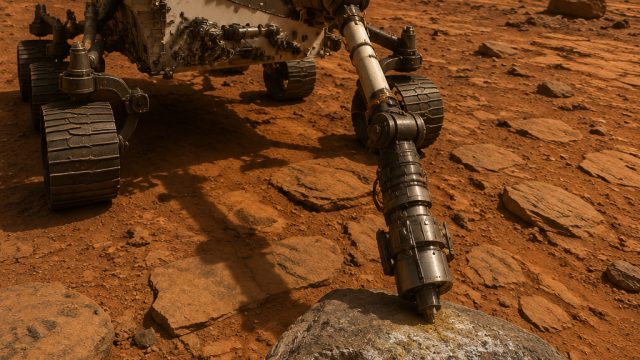
In a groundbreaking revelation, NASA's Perseverance rover has reportedly identified potential biosignatures on the Martian surface, suggesting that ancient microbial life may have once thrived on the Red Planet. This discovery, rich in complex organic carbon, is stirring excitement in the scientific community, offering a glimpse into Mars' enigmatic past.
Understanding the Discovery
The Perseverance rover has been meticulously exploring Jezero Crater, a site believed to have once housed a massive lake. Recent analyses focused on a Martian rock sample named Cheyava Falls have provided compelling evidence of ancient water and organic carbon compounds. These findings are pivotal, as they may indicate that Mars was not just a barren wasteland, but potentially a cradle for life as we know it.
What Are Biosignatures?
Biosignatures are indicators of past or present life, which can be found in various forms, including:
- Organic carbon: Molecules that are essential for life, such as amino acids and fatty acids.
- Chemical patterns: Specific reactions that only living organisms typically produce.
- Fossilized remains: Physical evidence of organisms that once existed.
The recent findings from the Mars rover highlight the first two types of biosignatures, leading scientists to reconsider our understanding of the planet's ability to harbor life.
The Importance of These Findings
Understanding the potential signs of ancient life on Mars is more than just an exciting scientific endeavor; it has profound implications for humanity's quest to comprehend our place in the universe. The implications include:
- Expanding our knowledge: Discovering life beyond Earth can fundamentally change our understanding of biology and the uniqueness of our planet.
- Future exploration: These findings may shape the direction of future missions, including the potential for sample collection and return missions.
- Inspiring a new generation: Renewed interest in space exploration could inspire young scientists and engineers to pursue careers in STEM fields.
What’s Next for the Perseverance Rover?
The Perseverance rover is equipped with advanced scientific tools that will continue to analyze Martian rocks and regolith. Future activities will include:
- Collecting samples: Perseverance is set to collect and store rock samples that could be returned to Earth in future missions.
- Conducting experiments: It will perform in-situ experiments to further analyze the chemical composition of Martian materials.
- Searching for life: The rover will continue its mission to explore and identify additional biosignatures.
Implications for Earth and Beyond
The potential discovery of ancient life on Mars doesn't just change our perspective on the Red Planet; it also raises questions about the origins of life on Earth. Some key considerations include:
- Life’s adaptability: If life could emerge and thrive on Mars, it suggests that life may be more common in the universe than previously thought.
- Planetary protection: Understanding how life can adapt to extreme environments can inform future missions to other celestial bodies.
- Philosophical implications: The discovery of extraterrestrial life might challenge our current philosophical and religious views about humanity's uniqueness in the cosmos.
The Search Continues
The journey to understanding Mars and its potential to host life is far from over. With ongoing missions and advancements in technology, scientists are more hopeful than ever. The Perseverance rover will not only help unravel the mysteries of Mars but could also pave the way for future human exploration.
Conclusion
NASA's recent findings from the Perseverance rover represent a significant step forward in our exploration of Mars and the search for extraterrestrial life. As scientists delve deeper into these revelations, we are reminded of the enduring mystery of our universe and the potential that lies beyond our home planet. The pursuit of knowledge continues, and with each discovery, we draw closer to answering one of humanity's oldest questions: are we alone in the universe?
